Best AI Writing Tools in 2026: Honest Rankings for Every Budget

Disclosure: This post may contain affiliate links. If you purchase through these links, we may earn a small commission at no extra cost to you.
TL;DR
- The AI writing tool market split in 2026: Claude and ChatGPT now outwrite most dedicated tools at a fraction of the price.
- For pure writing quality, Claude Pro ($20/mo) is the top pick for individuals. For long-form, brand-safe enterprise content, Jasper ($49+/mo) still earns its keep.
- For grammar and editing polish, Grammarly ($12/mo annual) remains unbeatable.
- SEO-specific writing now needs Writesonic's GEO tracking ($39+/mo) or Surfer SEO paired with Claude.
- Standalone AI writing tools that are just ChatGPT wrappers are dying. Don't pay premium prices for a rebadged chatbot.
Table of Contents
- Why 2026 Changed Everything for AI Writing Tools
- The Real Categories: What Kind of Writer Are You?
- Top AI Writing Tools Ranked and Reviewed
- Head-to-Head Comparison Table
- Which AI Writing Tool Is Right for You?
- The Free Tier Reality Check
- Conclusion: Stop Overpaying
- Related Articles
- FAQ

1. Why 2026 Changed Everything for AI Writing Tools {#changed}
Here's the uncomfortable truth the dedicated AI writing tool industry doesn't want you to know: the $39–$59/month tools are losing badly to $20/month general-purpose AI assistants.
In 2022, paying $49/month for Jasper made total sense. ChatGPT barely existed, and Jasper's templates were genuinely better than anything you could prompt out of early GPT-3. That advantage evaporated in 2024 and is completely gone in 2026.
Claude Opus 4.7 (released April 2026) produces writing that most professional editors would struggle to identify as AI-generated. ChatGPT with Canvas mode has turned into a collaborative editing environment that freelancers actually prefer over Google Docs for drafting. The tools that survived the great AI writing shakeout of 2025–2026 did so by getting more specific, not by competing head-on with the LLM giants.
That context matters for everything that follows. Before you spend money on any tool in this space, you need to know which tier you actually need — and which one is genuinely wasting your money.
2. The Real Categories: What Kind of Writer Are You? {#categories}
The AI writing landscape has organized itself into four distinct buckets. Being honest about which one you are will save you real money.
Bucket 1: Individual writers and content creators
You write blog posts, newsletters, scripts, or long-form articles. You care about voice, quality, and prose that doesn't sound like a press release. Claude or ChatGPT is almost certainly everything you need. Stop reading after the next section.
Bucket 2: Marketing teams needing brand consistency
You manage content across five or more writers and need every output to match a defined brand voice. You need approval workflows and collaboration features. This is where Jasper or Writer earns its premium pricing.
Bucket 3: SEO-focused content operations
You're producing content at scale with Google rankings as the primary KPI. You need keyword integration, SERP analysis, and content briefs built into the writing environment. Writesonic's pivot to GEO tracking or Surfer AI paired with Claude makes more sense than any general writing tool.
Bucket 4: Fiction and narrative writers
You write novels, scripts, or long-form creative work that needs story structure, character consistency, and lore management. Sudowrite or Novelcrafter — not ChatGPT — is your tool.
With that framework clear, here's the honest breakdown of what each tool actually delivers.

3. Top AI Writing Tools Ranked and Reviewed {#ranked}
🥇 Claude Pro — Best Overall for Individual Writers
Price: Free (limited) | $20/month (Pro) | $100/month (Max 5x) | $200/month (Max 20x)
Claude remains the writer's AI in 2026. The latest models — particularly Claude Opus 4.7 and Claude Sonnet 4.6 — produce prose with a quality ceiling no dedicated AI writing tool can match. Opus 4.7 introduced the ability to self-verify its own work mid-generation, catching logical inconsistencies and factual errors before they hit your draft.
What makes Claude the standout for writers specifically:
Artifacts: Claude generates a real-time document preview alongside the conversation. You can click into the artifact, edit directly, and have Claude rewrite specific sections without losing the rest of your draft. This is not how ChatGPT Canvas works — it's genuinely different and often better for long-form work.
Projects: Persistent context means Claude remembers your project details, writing style preferences, and key facts across conversations. This is the killer feature for anyone working on a book, a content series, or ongoing client work.
Voice matching: Paste three examples of your best writing and ask Claude to match the tone. The output accuracy is higher than any dedicated brand voice tool in testing. The difference is that Claude actually models style at the linguistic level rather than applying a template.
Limitations: No built-in SEO tools. No social media scheduling integration. Smaller third-party ecosystem than ChatGPT. If you need templates, Claude will make you build your own in Projects.
Best for: Long-form writers, content strategists, copywriters who care about prose quality over template speed.
🥈 ChatGPT Plus — Best for Versatility and Workflow Integration
Price: Free (limited GPT-5.2) | $8/month (Go) | $20/month (Plus) | $200/month (Pro)
ChatGPT's strength has always been ecosystem breadth. The Canvas mode — a side-panel editor where the AI makes targeted rewrites to specific sections — has become genuinely useful for collaborative editing workflows. The new Projects feature organizes your conversations, documents, and custom GPTs into structured workspaces.
Where ChatGPT wins over Claude for writing:
Third-party integrations: If your workflow touches Slack, Notion, Salesforce, or GitHub, ChatGPT's plugin ecosystem connects to more tools. Claude's integration story has improved but still lags behind.
Custom GPTs: You can build and share specialized writing assistants — a sales email GPT trained on your company's best-performing messages, a blog post GPT configured for your exact post structure. These are distributable in a way Claude's Projects aren't (yet).
Memory: ChatGPT's memory feature now surfaces relevant past conversations automatically. If you're a frequent user, it accumulates a useful working knowledge of your preferences and recurring projects.
Limitations: Writing quality, while excellent, sits slightly below Claude for sustained long-form work. Prose sometimes has a more formulaic rhythm that requires more editing passes. The free tier's capability jump to Plus is meaningful — the gap between Go ($8) and Plus ($20) is less clear.
Best for: Writers who need broad integrations, team collaboration via Custom GPTs, and platform flexibility.
🥉 Jasper — Best for Marketing Teams with Brand Voice Requirements
Price: Creator plan from $49/month | Teams from $69/month (annual pricing)
Jasper survived the general-purpose AI writing purge by getting specific: brand voice enforcement at scale. For a solo writer, Jasper makes no financial sense — Claude does everything it does for less. For a marketing team of five or more producing consistent content across multiple channels and writers, Jasper's value proposition is real.
The brand voice training feature lets you feed Jasper your company's style guide, tone examples, and banned phrases. Every writer on the team then generates content that stays within those guardrails automatically. No project kickoff call, no lengthy editor feedback loop — the brand consistency is baked into the generation layer.
Jasper's team collaboration tools include:
- Shared template libraries customized to your content types
- Approval workflows before content goes to publication
- Performance dashboards showing which content types perform best
The new AI routing feature — Jasper selects the best underlying model (Claude, GPT-5.5, or proprietary models) for each content type — is genuinely useful. You don't need to manage model selection per task.
Limitations: Starting at $49/month for a single Creator seat, it's expensive for individual use. The trial period is limited. Several competing tools have closed the brand voice gap at lower prices.
Best for: Marketing agencies, brand teams producing content at scale, and enterprises that need content governance.
✍️ Grammarly — Best Editing and Grammar Tool
Price: Free | Premium $12/month (annual) | Business $15/user/month
Grammarly is not an AI writing tool in the generation sense — it's an editing and polishing layer. What's changed in 2026 is that Grammarly's AI suggestions have gotten meaningfully better at detecting the specific patterns that mark AI-generated text (repetitive sentence length, passive overuse, hedging language) and flagging them for human editing.
For anyone using Claude or ChatGPT to generate first drafts, Grammarly Premium as the final editing pass is a genuinely useful combination. The $12/month annual price is the easiest spending decision on this list.
The Grammarly Business tier adds company-style guides, plagiarism detection across a team, and integration with Confluence, Google Docs, and Outlook — making it the lowest-friction way to apply editing standards across a content team.
Best for: Anyone who writes professionally and wants a grammar safety net. The price is hard to argue against.
📊 Writesonic — Best for SEO and GEO Content Operations
Price: Lite from $39/month (annual) | Standard $79/month | Professional $199/month (adds GEO tracking)
Writesonic's identity crisis resolved itself in 2025 when it pivoted to "AI Search Visibility Platform." The rebrand reflected a genuine product reality: its killer feature is GEO (Generative Engine Optimization) tracking — monitoring how your brand appears in AI-generated search results from ChatGPT, Perplexity, and Google AI Overviews.
As AI-powered search engines increasingly replace traditional blue-link results, appearing in these AI-generated summaries matters more than ranking position in standard SERPs. Writesonic tracks this in real time, connecting to your Google Search Console data to show gaps and opportunities.
The writing features are solid but secondary — the real value is the analytics and optimization layer. For content teams targeting AI search visibility, the Professional tier's GEO tracking pays for itself quickly.
Limitations: The pricing jump from the old $19/month to the current $39–$199/month range is significant. Pure content generation without GEO tracking doesn't justify the price versus Claude.
Best for: SEO content operations focused on AI search visibility, content teams with Google Search Console integration needs.
📚 Sudowrite / Novelcrafter — Best for Fiction Writers
Sudowrite price: $19/month (Hobby) | $29/month (Professional) | $59/month (Max)
Novelcrafter price: Free tier | AI tools from $10/month
These two tools sit in a category that Claude and ChatGPT genuinely can't match: structured fiction writing with character and lore consistency. Sudowrite's Muse model, fine-tuned on published fiction, produces dialogue and prose that matches genre conventions in a way general LLMs struggle with. The Story Engine (full draft from outline) and Describe/Rewrite/Expand editing tools are purpose-built for the fiction revision process.
Novelcrafter's Codex — a structured database of your characters, locations, magic systems, and world elements — solves the hardest problem in AI fiction writing: maintaining consistency across a 100,000-word manuscript. The AI references your Codex automatically during generation, so it actually knows your world's rules.
Best for: Fiction and creative writers working on novel-length projects who need story structure and character consistency tools.
4. Head-to-Head Comparison Table {#comparison}
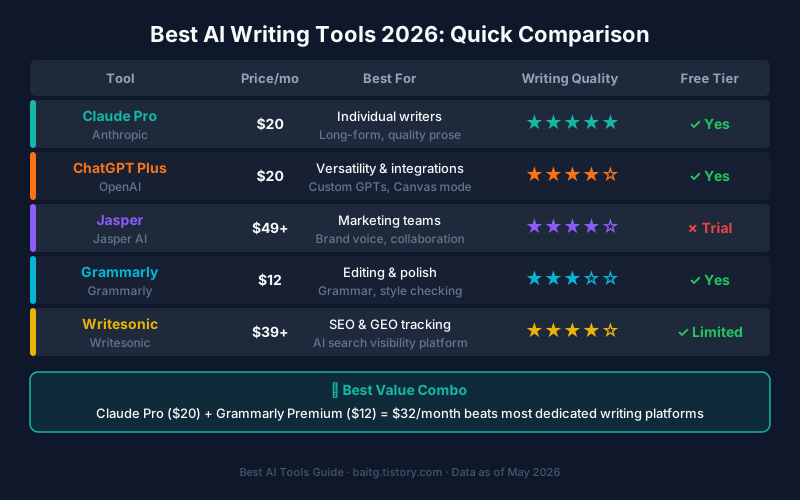
| Tool | Best For | Monthly Price | Free Tier | Writing Quality | Brand Voice | SEO Features |
|---|---|---|---|---|---|---|
| Claude Pro | Individual writers | $20 | ✅ Limited | ⭐⭐⭐⭐⭐ | Manual | ❌ |
| ChatGPT Plus | Versatility & integrations | $20 | ✅ Limited | ⭐⭐⭐⭐ | Custom GPTs | ❌ |
| Jasper | Marketing teams | $49+ | ❌ Trial only | ⭐⭐⭐⭐ | ⭐⭐⭐⭐⭐ | Basic |
| Grammarly | Editing & polish | $12 (annual) | ✅ | ⭐⭐⭐ | Company style guide | ❌ |
| Writesonic | SEO & GEO tracking | $39+ | ✅ | ⭐⭐⭐⭐ | Basic | ⭐⭐⭐⭐⭐ |
| Sudowrite | Fiction writing | $19 | ❌ | ⭐⭐⭐⭐⭐ (fiction) | N/A | ❌ |
| Novelcrafter | Long-form fiction | $10 | ✅ | ⭐⭐⭐⭐ | N/A | ❌ |
| Notion AI | Workspace integration | $19.50/user | ✅ | ⭐⭐⭐ | Basic | ❌ |
5. Which AI Writing Tool Is Right for You? {#which}
The decision tree is shorter than most review articles will admit:
If you write anything and you're an individual → Claude Pro at $20/month. Stop shopping.
If you're a marketing team needing brand consistency across multiple writers → Jasper from $49/month, or Writer for enterprise governance.
If your primary goal is SEO rankings and AI search visibility → Writesonic Professional + Surfer SEO, or build a Claude + Surfer workflow manually for less money.
If you write fiction at novel length → Sudowrite for prose quality, Novelcrafter for worldbuilding depth.
If you just want better grammar on existing writing → Grammarly Premium at $12/month annual. It's the easiest call on this list.
If your whole workflow lives in Notion → Notion AI at $19.50/user/month. Keep your writing where your notes are.
One strategy that works surprisingly well in 2026: combine Claude with Grammarly. Use Claude for generation and Grammarly for final editing. The combined cost ($20 + $12 = $32/month) undercuts most dedicated writing platforms while delivering better results than any single tool.
6. The Free Tier Reality Check {#free}
Every major tool now offers a free tier, but they're not all created equal. Here's what you actually get before handing over payment details:
Claude Free: Limited access to all Claude model tiers, including occasional access to Opus 4.7. The conversation length limits mean you'll hit walls on long-form work, but for short pieces and testing, it's genuinely usable.
ChatGPT Free: Access to GPT-5.2 Instant with Canvas mode. The free tier is significantly more capable than it was 12 months ago. For casual writing tasks, it's a real product.
Grammarly Free: Grammar and basic spell check — the foundational features work without paying. Premium adds style suggestions, tone detection, and plagiarism checking.
Writesonic Free: Limited monthly words and access to basic models. Not enough for professional content production, but enough to evaluate whether the GEO tracking features are worth it for your workflow.
Jasper: No meaningful free tier — trial access only with credit card required. The most restrictive on this list.
The practical conclusion: start with Claude Free and Grammarly Free. That combination covers the majority of individual writing needs at zero cost. Upgrade to Claude Pro when conversation limits become a friction point, which typically happens within two to three weeks of regular use.
7. Conclusion: Stop Overpaying {#conclusion}
The honest summary of the 2026 AI writing tool landscape is this: the market has bifurcated hard, and most users are paying for the wrong tier.
Individuals paying $39–$59/month for standalone AI writing platforms are almost certainly getting worse writing than they'd get from Claude Pro at $20/month. The dedicated tools justified their premiums when LLMs were weak. That era ended.
The tools that are genuinely worth premium prices in 2026 are the ones doing something Claude and ChatGPT can't: brand voice governance at scale (Jasper, Writer), GEO tracking and AI search analytics (Writesonic Professional), or fiction-specific prose tuning (Sudowrite).
If you don't need those specific features, save your money. Claude at $20/month is the best AI writing tool for most people in 2026 — not because Anthropic won the marketing battle, but because the output quality wins the honest comparison.
Related Articles {#related}
- Claude vs ChatGPT for Writing: Which Is Better in 2026?
- How to Use ChatGPT for SEO: Complete 2026 Guide + Prompts
- ChatGPT vs Claude vs Gemini (2026): Which AI Assistant Is Actually Worth It?
FAQ {#faq}
Q1: Is Claude better than Jasper for writing in 2026?
For individual writers, yes — Claude Pro produces higher-quality prose at $20/month vs Jasper's $49/month starting price. Jasper's advantage is brand voice enforcement and team collaboration features that make sense for marketing teams of five or more people, not solo creators.
Q2: What is the best free AI writing tool in 2026?
ChatGPT Free (GPT-5.2 Instant with Canvas) and Claude Free both provide genuinely usable free tiers. Grammarly Free handles basic grammar editing at no cost. For most casual writing needs, this combination costs nothing.
Q3: Can AI writing tools pass AI detection software in 2026?
This is a moving target, but the short answer is: with editing, yes. Raw AI output from most tools now triggers detection software. The best practice is to use AI for first drafts and structure, then rewrite key passages in your own voice. Claude consistently produces output that requires less editing to sound natural.
Q4: Is Writesonic worth it for SEO in 2026?
If GEO tracking — monitoring your brand's visibility in AI-generated search results — is a priority, Writesonic Professional ($199/month) is the only tool with this capability built in. For standard SEO content creation without GEO tracking, Claude plus Surfer SEO (separately) delivers comparable or better results at lower cost.
Q5: What's the best AI writing tool for teams?
For brand consistency and governance, Jasper or Writer. For individual writers on a shared budget, ChatGPT Team plans or a Claude Team subscription. The right answer depends on whether your team's primary need is brand voice enforcement (Jasper wins) or raw capability and flexibility (Claude or ChatGPT wins).
Disclosure: This post may contain affiliate links. If you purchase through these links, we may earn a small commission at no extra cost to you.


