How to Use ChatGPT for SEO: Complete 2026 Guide + Prompts
Disclosure: This post may contain affiliate links. If you purchase through these links, we may earn a small commission at no extra cost to you.
TL;DR
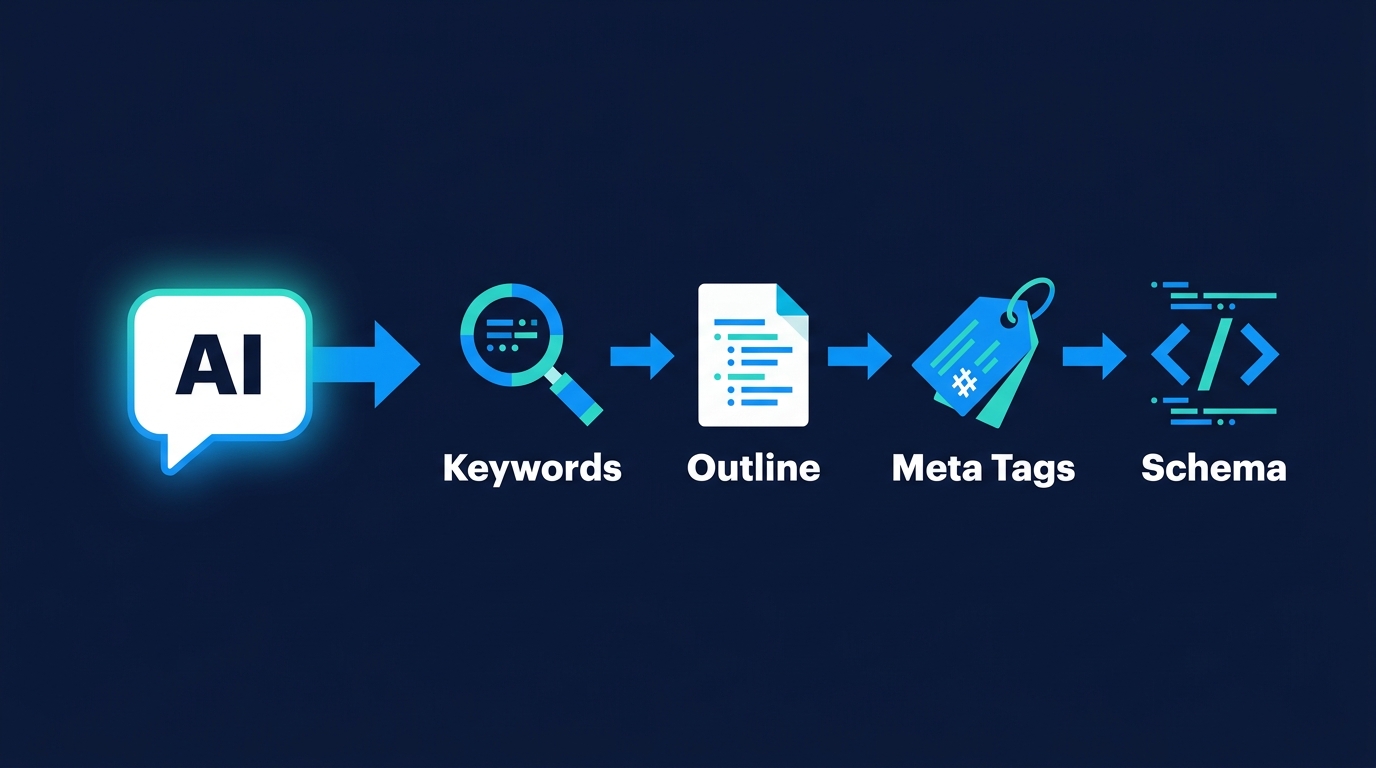
- ChatGPT can dramatically accelerate 10+ SEO tasks: keyword research, content outlines, meta tags, schema markup, internal linking, and more.
- Critical limitation: ChatGPT cannot provide live keyword search volumes or difficulty scores — always pair it with Ahrefs, Semrush, or Google Keyword Planner for real data.
- In 2026, using ChatGPT for SEO means optimizing for two environments: traditional Google rankings AND AI-generated answers (GEO).
- The best results come from combining specific prompts with human editorial judgment — never publish AI SEO output without reviewing it first.
Table of Contents
- Why ChatGPT Has Become an SEO Workflow Essential
- What ChatGPT Can (and Can't) Do for SEO
- Step 1: Keyword Research & Topic Clustering
- Step 2: Content Outlines & Structure
- Step 3: Writing & Optimizing Meta Tags
- Step 4: Schema Markup & Technical SEO
- Step 5: Internal Linking Strategy
- Step 6: Optimizing for AI Search (GEO)
- Best Prompts for Each SEO Task
- Conclusion
- Related Articles
- FAQ
1. Why ChatGPT Has Become an SEO Workflow Essential {#why}
SEO has always been about producing better, more relevant content faster than the competition. For years, that meant hiring skilled writers, spending hours on keyword research, and manually optimizing each piece for search. AI has restructured this calculus entirely.
ChatGPT, in its 2026 form running on GPT-5.5, can take tasks that previously consumed an SEO's afternoon and reduce them to a 10-minute workflow. A keyword cluster that would require an hour of spreadsheet work gets done in one prompt. A 1,500-word content brief that used to require a senior strategist becomes a 3-minute conversation. Meta descriptions for 50 product pages become a batch-processing task.
The critical caveat — and the reason this guide exists — is that ChatGPT used incorrectly in an SEO context can actually hurt your rankings. Publishing AI-generated content without editorial review, relying on ChatGPT for keyword volume data it can't accurately provide, or generating thin content at scale are all practices that create problems rather than solving them.
This guide focuses on what actually works: specific use cases, specific prompts, and specific quality controls.
2. What ChatGPT Can (and Can't) Do for SEO {#canandcant}
Before building prompts, be clear about the tool's actual capabilities:
ChatGPT CAN Help You With:
| SEO Task | ChatGPT's Usefulness |
|---|---|
| Generating keyword ideas & long-tail variations | ⭐⭐⭐⭐⭐ Excellent |
| Clustering keywords by topic and intent | ⭐⭐⭐⭐⭐ Excellent |
| Writing and testing content outlines | ⭐⭐⭐⭐⭐ Excellent |
| Drafting and optimizing meta titles & descriptions | ⭐⭐⭐⭐ Very Good |
| Generating JSON-LD schema markup code | ⭐⭐⭐⭐ Very Good |
| Building internal linking strategies | ⭐⭐⭐⭐ Very Good |
| Identifying content gaps vs. competitors | ⭐⭐⭐ Good (with data input) |
| Writing first drafts for SEO-optimized content | ⭐⭐⭐ Good (requires editing) |
| Analyzing crawl logs and technical SEO issues | ⭐⭐⭐ Good (with raw data provided) |
ChatGPT CANNOT Reliably Do:
- Provide live keyword search volumes or difficulty scores — it will hallucinate metrics. Always use Ahrefs, Semrush, or Google Keyword Planner for real data.
- Crawl and audit your live website — it has no direct access to your server or Google Search Console.
- Guarantee ranking outcomes — no AI can promise specific ranking results.
- Replace strategic SEO judgment — it can suggest tactics, but it can't evaluate your domain's competitive position or budget constraints.
3. Step 1: Keyword Research & Topic Clustering {#keyword}
ChatGPT's most underrated SEO use is topic clustering — taking a messy list of keywords and organizing them by semantic relevance and search intent. This work is tedious when done manually and essential for building topical authority with Google's current ranking algorithms.
How to Do It
Prompt for initial keyword generation:
Act as an SEO strategist. I run a blog about [your topic]. Generate 25 long-tail keyword ideas that a [target audience] would search for when looking for [specific problem or goal]. Include a mix of informational ("how to," "what is"), commercial ("best," "review"), and transactional ("buy," "pricing") intent keywords.Prompt for keyword clustering:
Here is a list of keywords: [paste your keyword list].

Group them into topic clusters based on semantic relevance. For each cluster:
1. Assign a primary keyword (highest search intent, most specific)
2. List supporting keywords (2-5 per cluster)
3. Label the search intent (informational / commercial / transactional)
4. Recommend the best content format (blog post, landing page, comparison page, FAQ page)Important: Once ChatGPT generates your clusters, validate actual search volumes and competition scores in Ahrefs or Semrush before investing content production time. ChatGPT's clustering logic is excellent; its volume estimates are not reliable.
Pro Tip: Feed It Your Competitor's URL
ChatGPT can analyze a competitor's public content structure if you paste in a page's text or describe what you see. Ask it to identify topic gaps — areas the competitor covers that you don't, or angles they've missed that you could exploit.
4. Step 2: Content Outlines & Structure {#outline}
A strong SEO content outline does three things: organizes ideas logically, ensures every ranking keyword is addressed naturally, and creates a structure that keeps readers on the page long enough to satisfy Google's engagement signals.
ChatGPT can generate all three in one prompt.
Outline Prompt Template
Act as an expert SEO content strategist. Create a detailed outline for a blog post targeting the keyword "[your main keyword]."

Requirements:
- Target audience: [describe your reader]
- Estimated word count: [2,000–2,500 words]
- Include: Introduction hook, H2 headings (5–7), H3 subheadings under each H2, a comparison table, an FAQ section (5 questions), and a conclusion
- Incorporate these related keywords naturally: [list 5–8 related keywords]
- Format the outline with word count targets per section
What to Look for in the Output
A good AI-generated outline will show search intent alignment (are the H2 headings actually what people are looking for?), keyword coverage without forced repetition, and a logical reading progression. A mediocre outline will be generic, use clickbait headings, or structure the content to match what the AI thinks "SEO content" looks like rather than what your specific audience needs.
When in doubt, compare the AI outline to the top 3 ranking pages for your target keyword. If your outline covers significantly different ground, revise it before writing.
5. Step 3: Writing & Optimizing Meta Tags {#meta}
Meta titles and descriptions have a disproportionate impact on click-through rates — a well-written meta description won't change your ranking but can dramatically change how many people actually click on it.
Meta Title Prompt
Write 5 SEO meta titles for a blog post about "[topic]."

Requirements:
- Primary keyword: [keyword]
- Each title must be under 60 characters
- Include a power word or number where natural
- Avoid clickbait — these should accurately describe the content
- Format: numbered list with character count for each
Meta Description Prompt
Write 3 meta descriptions for a blog post about "[topic]."

Requirements:
- Primary keyword: [keyword] — place it in the first 20 words
- Each description must be 140–160 characters
- Include a clear value proposition or action prompt
- Make each one meaningfully different in angle or emphasis
- Format: numbered list with character count
Quality Check
After ChatGPT generates these, manually verify:
- Is the character count actually within spec? (ChatGPT miscounts occasionally)
- Does the meta description match what the page actually covers?
- Does the title feel like something a real person would write and click on?
6. Step 4: Schema Markup & Technical SEO {#technical}
This is where many content-focused SEOs underuse ChatGPT. Technical SEO tasks — particularly schema markup generation — are exactly the kind of structured, repetitive work that AI handles with high accuracy.
FAQ Schema Prompt
Generate valid JSON-LD FAQ schema markup for the following questions and answers. Format it as ready-to-paste code:

Q1: [your question]
A1: [your answer]

Q2: [your question]
A2: [your answer]

[continue for all FAQs]
After generating the code, test it in Google's Rich Results Test (search.google.com/test/rich-results) before deploying it to your live site.
Other Technical SEO Prompts That Work Well
- Robots.txt rules: "Generate a robots.txt entry that blocks GPTBot from crawling my site's /private/ directory while allowing all other bots."
- Hreflang tags: "Write hreflang tags for a page that targets US English, UK English, and Canadian English audiences."
- Crawl log analysis: "I'm pasting a sample from my server crawl log. Identify any Googlebot crawl anomalies, unusual 404 patterns, or redirect loops."
- RegEx for GSC filtering: "Write a Google Search Console RegEx filter to show only queries containing 'best' that triggered pages in my /blog/ directory."
7. Step 5: Internal Linking Strategy {#internal}
Internal links distribute page authority across your site and help Google understand your content hierarchy. Building an internal linking strategy manually across a 50+ page site is time-consuming; ChatGPT can significantly speed up the process.
Internal Linking Audit Prompt
Here are the titles and URLs of my 15 most important blog posts:
[paste list of post titles and URLs]

For each post, suggest 3 internal links TO that post from other posts in my list, using natural anchor text that fits the context. Format as a table with columns: Post Title | Link From | Suggested Anchor Text.
New Post Link Integration Prompt
I'm publishing a new blog post titled "[new post title]" targeting the keyword "[keyword]."

Here are my existing posts: [paste list]

Which 4 existing posts should I link to from this new post, and what anchor text should I use for each? Also, which 3 existing posts should link TO this new post, and where in those articles would a natural link fit?
The output won't be perfect — review every suggestion and only add links where they genuinely add reader value. Google's quality guidelines penalize internal linking that feels forced.
8. Step 6: Optimizing for AI Search (GEO) {#geo}
This is the part of ChatGPT SEO that most guides from 2024 missed entirely, and it's increasingly important in 2026.
GEO (Generative Engine Optimization) is the practice of optimizing your content to be cited in AI-generated answers — from ChatGPT, Perplexity, Google AI Overviews, and other LLMs.
The distinction matters: SEO targets Google's link-based results; GEO targets AI-generated answer summaries. As Gartner predicted, traditional search volume is declining as more users start research in AI rather than Google. Being in AI answers is a new form of brand visibility.
What Makes Content AI-Citation-Worthy
Research on AI citation patterns shows several consistent factors:
- Fact density: Content that states specific facts, statistics, and data points gets cited more often than opinion-heavy or vague content.
- Structural clarity: Well-organized content with clear headings, definitions, and step-by-step structures is easier for AI to extract accurate summaries from.
- Authority signals: Sites with strong backlink profiles and established domain authority are cited far more often — sites with 32,000+ referring domains are roughly 3.5x more likely to appear in ChatGPT answers.
- Direct answer formatting: Content that directly answers the question asked (not buried in context) performs better.
ChatGPT Prompt for GEO Optimization
Here is a draft of my blog post about "[topic]": [paste content]

Rewrite the introduction and key sections to be more likely to be cited by AI models like ChatGPT and Perplexity. Specifically:
- Make the first 3 sentences directly answer the likely user question
- Add specific statistics, data points, or facts where claims are currently vague
- Structure each key section with a clear definition, then explanation, then practical example
- Keep the tone factual and authoritative rather than casual
9. Best Prompts for Each SEO Task {#prompts}
A quick reference table of the most useful ChatGPT prompts for SEO workflows:
| SEO Task | Core Prompt Pattern |
|---|---|
| Keyword brainstorming | "Generate 20 long-tail keywords for [topic] targeting [audience] with [intent] intent" |
| Keyword clustering | "Group these [N] keywords by semantic topic and search intent" |
| Content outline | "Create a 2,200-word outline for a post targeting '[keyword]' for [audience]" |
| Meta title | "Write 5 meta titles under 60 characters for a post about '[topic]'" |
| Meta description | "Write 3 meta descriptions 140–160 characters for a post about '[topic]'" |
| FAQ schema | "Generate JSON-LD FAQ schema markup for these questions: [list]" |
| Internal linking | "Suggest internal linking opportunities between these posts: [list]" |
| Competitor gap analysis | "Identify content angles that [competitor] misses based on this page: [paste]" |
| GEO optimization | "Rewrite this section to be more likely cited by AI models: [paste]" |
| Outreach email | "Write a link outreach email for a post about '[topic]' targeting [site type]" |
10. Conclusion {#conclusion}
ChatGPT is not an SEO magic button. Used well, it's one of the most significant productivity multipliers available to content teams and SEO practitioners today — compressing hours of keyword, structural, and technical work into minutes. Used poorly, it produces thin, generic content that can actively harm your rankings.
The practical takeaway from this guide is straightforward: use ChatGPT where it excels (ideation, clustering, structuring, drafting, and code generation) and continue using dedicated tools where it can't (live keyword data, site audits, backlink analysis). Layer GEO thinking into every piece you publish in 2026 — because the search results page your content needs to appear on is increasingly inside an AI assistant, not just Google.
Start with one task from this guide — keyword clustering or meta description generation are the fastest wins — and build from there.
Related Articles {#related}
- How to Write Better AI Prompts: A Beginner's Complete Guide (2026)
- Best AI Tools for Marketing in 2026
- Top 10 AI Tools for Small Business Owners in 2026
FAQ {#faq}
Q1: Can ChatGPT replace traditional SEO tools like Ahrefs or Semrush?
No — and it's important to understand why. ChatGPT cannot access live keyword search volume, difficulty scores, backlink databases, or technical site audit data. It's excellent for the thinking and writing parts of SEO; dedicated tools like Ahrefs or Semrush are still required for the data parts. The best workflow combines both.
Q2: Will Google penalize content written with ChatGPT?
Google's guidelines focus on content quality and helpfulness, not the tool used to create it. AI-generated content that is reviewed, edited, and genuinely useful for readers is treated the same as human-written content. Thin, repetitive, or clearly unedited AI content — the kind published at scale without human oversight — can trigger quality penalties.
Q3: What's the best ChatGPT model to use for SEO tasks?
GPT-5.5 (available on ChatGPT Plus at $20/month) produces meaningfully better outputs for SEO writing tasks than free-tier models. For schema markup generation and technical prompts, the difference is smaller. If you're on a free tier, it's worth upgrading for content work — the output quality difference justifies the cost.
Q4: How do I know if ChatGPT's SEO advice is accurate?
Treat ChatGPT's SEO outputs as a first draft, not a final answer. For anything involving tactics or strategies, cross-reference against authoritative SEO sources (Google's Search Central documentation, Ahrefs blog, Semrush blog). For technical outputs like schema markup, always test in Google's Rich Results Test before deploying.
Q5: What is GEO and should I be optimizing for it?
GEO (Generative Engine Optimization) is optimizing your content to appear in AI-generated answers from tools like ChatGPT, Perplexity, and Google AI Overviews. Given that AI search queries are growing rapidly and traditional search volume is gradually shifting, yes — any content strategy in 2026 should incorporate basic GEO principles: fact density, clear structure, and authoritative sourcing.
Disclosure: This post may contain affiliate links. If you purchase through these links, we may earn a small commission at no extra cost to you.

