Best AI Tools for Marketing in 2026: The Stack That Actually Works

Disclosure: This post may contain affiliate links. If you purchase through these links, we may earn a small commission at no extra cost to you.
TL;DR
- The best AI marketing stack in 2026 combines tools for content creation, SEO optimization, workflow automation, and AI visibility tracking.
- Top picks: ChatGPT/Claude for drafting, Surfer SEO for optimization, HubSpot for automation, Jasper for brand-consistent copy, and Perplexity for research.
- The biggest 2026 shift: marketing now requires tracking your brand's presence in AI search answers (GEO), not just Google rankings.
- 88% of marketers now use AI in daily operations — falling behind is no longer a risk, it's already a reality for teams that haven't adapted.
Table of Contents
- Why AI Marketing Tools Have Shifted From Optional to Essential
- The 2026 Marketing AI Stack: 5 Core Categories
- Best AI Tools for Content Creation & Writing
- Best AI Tools for SEO & Search Visibility
- Best AI Tools for Automation & Workflow
- Best AI Tools for Analytics & Research
- How to Build Your Stack Without Overspending
- Conclusion
- Related Articles
- FAQ
1. Why AI Marketing Tools Have Shifted From Optional to Essential {#essential}
There's a version of this article from two years ago that would have opened with "AI tools can give your marketing team a competitive edge." That framing is obsolete.
In 2026, 88% of marketers use AI in their daily operations. ChatGPT alone reaches approximately 900 million weekly active users; Google Gemini is close behind at 750 million monthly. These are the environments where people discover brands, research products, and make purchase decisions. If your marketing strategy doesn't account for AI-generated answers and AI-assisted content production, you're working in 2023 while your competitors are working in 2026.
The good news: AI tools haven't made marketers obsolete. They've made the gap between good and mediocre marketers wider. Teams that use AI to move faster, personalize deeper, and optimize continuously are pulling ahead — not because they replaced human creativity, but because they augmented it.
This guide covers the tools worth actually paying for, organized by the marketing job they do best.
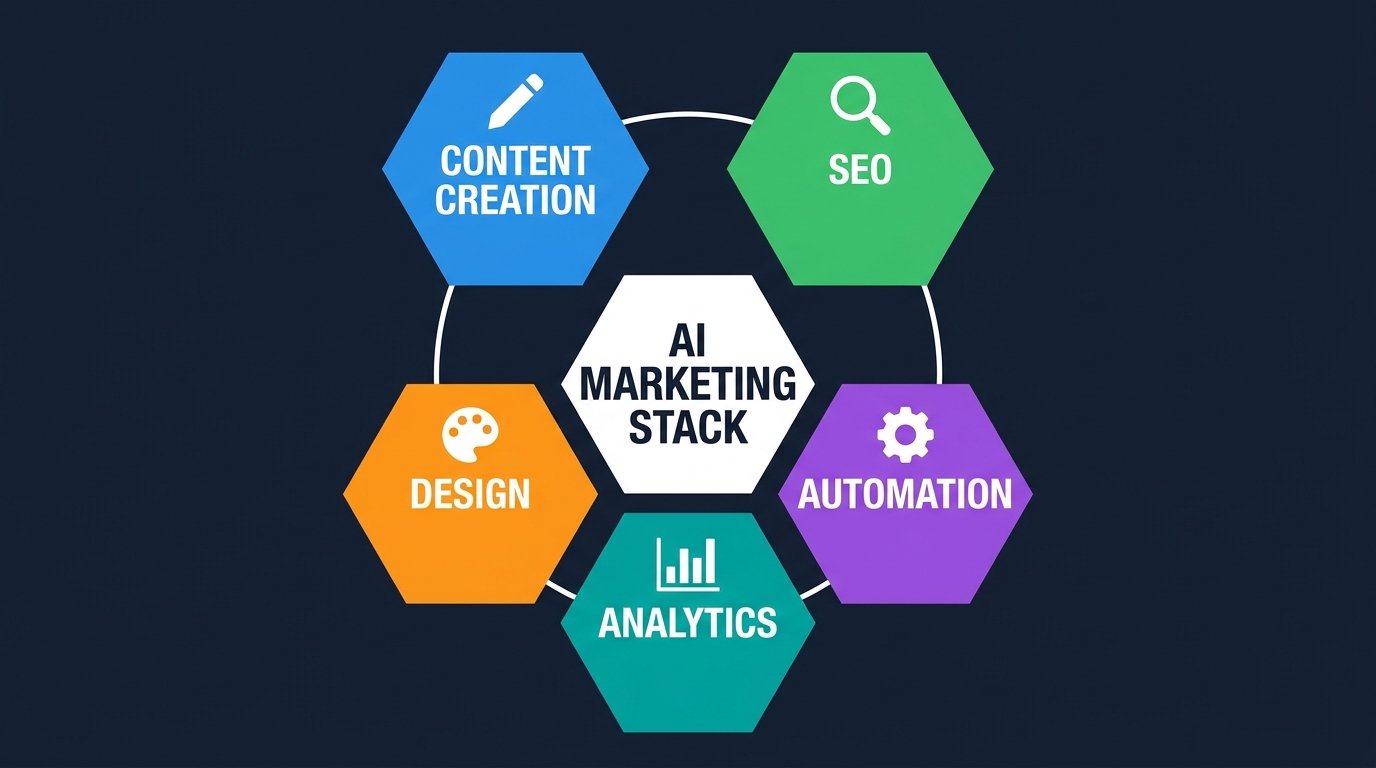
2. The 2026 Marketing AI Stack: 5 Core Categories {#categories}
A strong 2026 AI marketing stack isn't a single app — it's a layered system:
| Category | What It Does | Top Picks |
|---|---|---|
| Content Creation | Draft, refine, and repurpose copy at scale | ChatGPT, Claude, Jasper |
| SEO & Search Visibility | Optimize for Google + AI-generated search answers | Surfer SEO, Semrush, Atomic AGI |
| Automation & Workflow | Connect tools and eliminate manual steps | Zapier, Gumloop, HubSpot |
| Analytics & Research | Surface insights from campaign and audience data | Cometly, HubSpot, Perplexity |
| Design & Creative | Generate visuals, landing pages, and brand assets | Canva AI, Figma AI, v0 |
The most common mistake marketers make is adopting too many overlapping tools. The goal is coverage across all five categories with minimal overlap and a clear data flow between them.
3. Best AI Tools for Content Creation & Writing {#content}
ChatGPT (OpenAI) — Best for Fast Iteration
Best for: Marketing teams that need high-volume drafts across formats
Price: Free tier available; Plus at $20/month; Business at $30/user/month
ChatGPT remains the most widely used AI writing assistant in marketing. Its strength is versatility — in a single session, you can draft a blog post outline, rewrite it for email, extract three social posts, and generate five subject line variations. GPT-5.5's improved conversational memory means it retains your brand voice and audience context across a working session without you re-explaining them each time.
For team use, the Business plan is strongly recommended: OpenAI does not train on Business or Enterprise data by default, and the workspace features make collaborative prompting workflows easier to manage.
Best for: Fast iteration, team collaboration, consistent format outputs.
Claude (Anthropic) — Best for Long-Form & Natural Voice
Best for: Long-form blog content, research synthesis, brand voice writing
Price: Free tier available; Pro at $20/month; Max tiers at $100–$200/month
Claude handles longer context windows better than most alternatives, making it the preferred tool for marketers who deal with substantial source materials — research reports, lengthy briefs, or full content audits. Its output tends to read more naturally and pass AI detection tools more reliably than ChatGPT's for flowing prose.
Anthropic positions Claude for "deeper, more agentic workflows" in 2026, which translates practically to better performance on structured writing tasks that require consistent reasoning across thousands of words.
Best for: Longer context, careful synthesis, and content that needs a genuinely human-sounding voice.
Jasper — Best for Brand-Consistent Copy at Scale
Best for: Agencies and in-house teams managing multiple brands or channels
Price: From $49/month (Creator); Team plans from $125/month
Jasper's primary value proposition in 2026 is brand voice management. Rather than prompting a general AI with style instructions every time, Jasper stores your brand voice, tone guidelines, and audience personas as permanent settings. Every output pulls from these settings automatically — meaning a team of five writers can produce content that reads consistently without a style-guide reminder at the top of every prompt.
For agencies managing five or more brand voices simultaneously, the consistency payoff is meaningful.
Best for: High-volume on-brand copy across multiple clients or channels.
4. Best AI Tools for SEO & Search Visibility {#seo}
Surfer SEO — Best for On-Page Content Optimization
Best for: Bloggers, content strategists, and agencies prioritizing organic rankings
Price: From $99/month (Essential plan)
Surfer has become the industry standard for on-page SEO optimization, and for good reason. You enter a target keyword, Surfer analyzes the top-ranking pages for that query, and gives you a real-time Content Score that evaluates keyword density, semantic terms, heading structure, content length, and dozens of other factors as you write.
The keyword clustering feature is particularly valuable for building topical authority — it groups related keywords into content hubs aligned with how search engines evaluate expertise. In an era where Google rewards comprehensive topic coverage over isolated keyword targeting, this matters.
Bottom line: Surfer won't write your content, but it will tell you exactly what that content needs to rank.
Semrush — Best All-in-One SEO Suite
Best for: Full-funnel SEO teams and agencies
Price: From $139.95/month (Pro plan)
Semrush's AI-enhanced features in 2026 go beyond the keyword research and backlink analysis it was already known for. The ContentShake AI feature generates SEO-optimized article drafts directly within the platform, and the AI Writing Assistant scores your content against competitive benchmarks in real time. For teams that want their keyword research, competitive analysis, technical SEO audits, and content optimization in a single platform, Semrush remains the most comprehensive option.
Atomic AGI — Best for AI Search Visibility (GEO)
Best for: Brands investing in Generative Engine Optimization (GEO)
Price: Available on request
This is the newest category in the list and arguably the most important one for long-term marketing strategy. Atomic AGI tracks your brand's appearance in AI search responses — meaning how often ChatGPT, Perplexity, Google AI Overviews, and other LLMs mention or cite you when users ask relevant questions.
Why does this matter? Research suggests that sites with strong authority signals are roughly 3.5x more likely to be cited in AI-generated answers. If your brand isn't in AI answers, you simply don't exist for a growing share of users who start their research in AI rather than Google.
5. Best AI Tools for Automation & Workflow {#automation}
HubSpot Marketing Hub — Best for CRM-Integrated Marketing Automation
Best for: Mid-market and enterprise teams wanting CRM, email, and AI in one platform
Price: Free tier for basic tools; Starter from $15/seat/month; Professional from ~$890/month
HubSpot's AI-powered Breeze agents can automatically resolve over 65% of customer service conversations, while the marketing automation layer handles lead scoring, email sequences, social media scheduling, and campaign attribution. The core advantage is data unity — because your CRM, email tool, and analytics live in the same platform, HubSpot can make genuinely intelligent recommendations based on the full customer journey rather than siloed data.
For smaller teams, the free tier provides surprising value. For teams running complex multi-channel campaigns, Professional is where the real automation power kicks in.
Zapier — Best for Connecting Your Existing Stack
Best for: Growth and operations teams that need reliable no-code automation
Price: Free plan (100 tasks/month); Pro from $19.99/month; Team from $69/month
If your challenge isn't a missing tool but disconnected tools, Zapier is the solution. It connects thousands of apps — routing leads from your ad platforms into your CRM, triggering email sequences when someone downloads a lead magnet, syncing customer data between tools, and flagging high-intent signals for sales follow-up.
The newer "AI orchestration" features add a layer of intelligence: instead of static if-this-then-that rules, you can build workflows where an AI step decides what action to take based on context.
Gumloop — Best for Advanced AI-Powered Workflows
Best for: Teams comfortable building custom AI automation flows
Price: Free tier available; pricing scales with usage
Gumloop is one of the most talked-about automation tools among marketing practitioners in 2026. Think of it as Zapier with a native AI layer — you can connect any LLM (ChatGPT, Claude, Grok, and others) to your internal tools and external platforms without writing code. Teams at Webflow, Instacart, and Shopify use it for workflows like automated competitive intelligence, sentiment analysis on social media, and content repurposing pipelines.
The key differentiator: Gumloop provides access to premium LLMs directly, so you don't need separate API keys for each model.

6. Best AI Tools for Analytics & Research {#analytics}
Perplexity — Best for Real-Time Research
Best for: Marketers who need cited, sourced answers to research questions
Price: Free tier available; Pro at $20/month
Perplexity is an AI search engine that provides answers with direct citations, making it significantly more useful for marketing research than general-purpose chatbots. When you need to understand competitor positioning, research industry trends, or find supporting data for a campaign brief, Perplexity's source-citing format saves the verification step that generic AI output requires.
Cometly — Best for Multi-Touch Attribution
Best for: Paid media teams needing accurate attribution across channels
Price: From $49/month; enterprise pricing available
With iOS privacy changes and third-party cookie deprecation fragmenting ad measurement data, Cometly's server-side tracking solves a genuine problem. Its AI Ads Manager analyzes campaign performance patterns and delivers specific optimization recommendations — not just what happened, but what to do next. The natural language interface means non-technical marketers can query their data conversationally.
7. How to Build Your Stack Without Overspending {#budget}
The temptation with AI marketing tools is to buy everything at once. A more effective approach is to start with your biggest time drain and layer from there.
Recommended build order by team size:
| Team Size | Start With | Add Next | Advanced |
|---|---|---|---|
| Solo / Freelancer | ChatGPT Plus ($20) + Surfer SEO ($99) | Zapier free tier | Claude Pro ($20) |
| Small Team (2–5) | HubSpot Starter + ChatGPT Business | Jasper ($49+) | Gumloop |
| Agency (5+) | HubSpot Professional + Jasper Team | Semrush + Cometly | Atomic AGI |
A few principles worth keeping in mind as you build:
Data privacy matters more than you think. For client work, use Business or Enterprise AI plans wherever possible — most major providers do not train models on data from these plans. Review each tool's data handling terms before feeding in customer data.
Integration before expansion. A smaller stack that talks to itself is more powerful than a larger stack where data is siloed. Before adding a new tool, ask: does it connect to what I already use?
Measure AI ROI in time, not just money. The standard ROI metric for AI tools is hours saved — track it explicitly in the first 30 days of any new tool adoption.
8. Conclusion {#conclusion}
The best AI marketing stack in 2026 isn't a single platform. It's a system — one that combines content generation, SEO optimization, workflow automation, and AI visibility tracking in a way that's specific to your team's workflows and bottlenecks.
Start small, measure honestly, and expand deliberately. The tools covered in this guide represent the most proven options in each category, but the real competitive advantage isn't which tools you use — it's how well you've integrated them into a repeatable system.
For most marketing teams, the single highest-ROI move in 2026 is combining an AI writing assistant (ChatGPT or Claude) with an SEO optimization tool (Surfer SEO or Semrush) and a workflow automation layer (Zapier or HubSpot). That combination — costing roughly $150–250/month total — will outperform any single all-in-one platform at that budget.
Related Articles {#related}
- Best AI Tools for Freelancers in 2026: The Honest Stack That Actually Saves Time
- How to Use AI for Content Creation: 6 Practical Workflows
- ChatGPT vs Claude for Writing: Which AI Is Actually Better in 2026?
FAQ {#faq}
Q1: What is the best AI tool for marketing in 2026?
There's no single best tool — the answer depends on your team's primary bottleneck. For content creation, ChatGPT Plus or Claude Pro are the starting points for most marketers. For SEO optimization, Surfer SEO is the industry standard. For full-stack automation, HubSpot Professional is the most integrated option.
Q2: How much should a small business spend on AI marketing tools?
A functional small-business AI marketing stack can run $50–$150/month: ChatGPT Plus ($20) for content drafting, Surfer SEO ($99) for optimization, and Zapier's free tier for basic automation. Scaling up from there depends on your content volume and team size.
Q3: Is AI actually replacing marketing jobs?
Not replacing — reshaping. The marketers who are losing work are those doing tasks AI does cheaply: generating generic content, manually resizing images, writing repetitive email copy. The marketers thriving are those who can direct AI strategically, interpret its outputs critically, and focus on the creative and analytical work AI still can't do well.
Q4: What is GEO and why does it matter for marketers?
GEO (Generative Engine Optimization) is the practice of optimizing your content to be cited in AI-generated answers — from ChatGPT, Perplexity, Google AI Overviews, and similar tools. As more users start their research in AI rather than traditional search, being referenced in AI answers becomes a meaningful source of brand visibility and trust.
Q5: Can I use AI marketing tools for free?
Several strong free tiers exist: ChatGPT's free plan, HubSpot's free CRM and basic marketing tools, Perplexity's free research tier, and Zapier's free automation plan (100 tasks/month). For serious content production and SEO optimization, you'll eventually hit the limits of free tiers, but they're excellent for evaluation before committing to paid plans.
Disclosure: This post may contain affiliate links. If you purchase through these links, we may earn a small commission at no extra cost to you.

