Claude 4 Explained: Sonnet 4.6, Opus 4.7, and the Mystery of Mythos (2026)

Disclosure: This post may contain affiliate links. If you purchase through these links, we may earn a small commission at no extra cost to you.
TL;DR
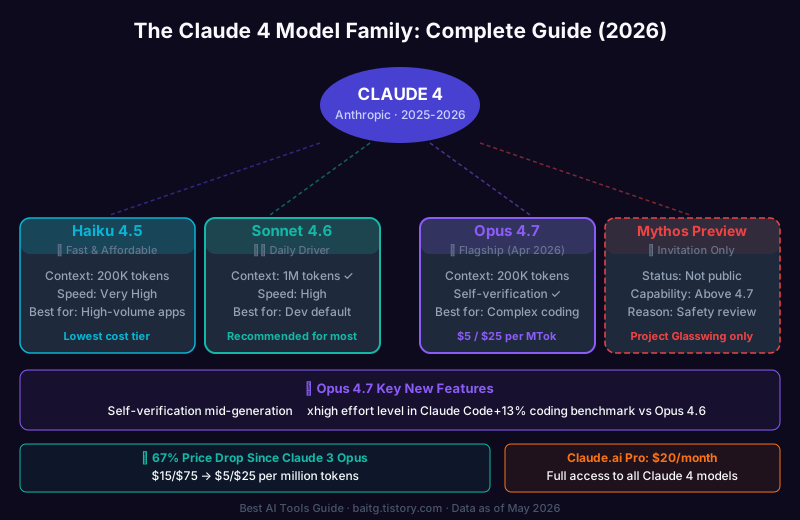
- The Claude 4 family in 2026 spans multiple tiers: Haiku 4.5 (fast/cheap), Sonnet 4.6 (daily driver), Opus 4.7 (flagship reasoning), and the invitation-only Mythos Preview.
- Claude Opus 4.7, released April 16, 2026, is Anthropic's current publicly available frontier model — stronger than Opus 4.6 on coding, vision, and self-verification of its own reasoning.
- Claude Sonnet 4.6 is the workhorse of the family: 1M token context window, strong reasoning, and available at Sonnet-tier pricing — making it the default choice for most developers and heavy users.
- Mythos Preview is a more capable model that Anthropic has deliberately withheld from public release over safety concerns. It exists and is being used by selected cybersecurity researchers.
- Pricing remains competitive: Opus 4.7 at $5/$25 per million input/output tokens — a 67% reduction from original Claude 3 Opus pricing.
Table of Contents
- What Is the Claude 4 Family?
- Claude Sonnet 4.6: The Everyday Powerhouse
- Claude Opus 4.7: The Flagship Model Explained
- Claude Haiku 4.5: Fast and Affordable
- Claude Mythos Preview: The Model Anthropic Won't Release
- Claude 4 vs. The Competition: How It Stacks Up
- Pricing: What Claude 4 Costs in 2026
- Who Should Use Which Claude Model?
- Conclusion: The State of Claude in 2026
- Related Articles
- FAQ

1. What Is the Claude 4 Family? {#family}
Anthropic's Claude has evolved from a single model into a full product family, and keeping track of the tiers, version numbers, and naming conventions requires some orientation. If you've been using Claude for a while, the jump from "Claude 3.5 Sonnet" to "Claude Sonnet 4.6" may have felt confusing. Here's the clear breakdown.
The Claude 4 generation refers to a series of models built on Anthropic's fourth-generation architecture, each optimized for a different point on the capability-speed-cost curve:
| Model | Tier | Primary Use Case | Context Window |
|---|---|---|---|
| Claude Haiku 4.5 | Fast & affordable | High-volume, latency-sensitive tasks | 200K tokens |
| Claude Sonnet 4.6 | Balanced | Developer default, heavy professional use | 1M tokens |
| Claude Opus 4.7 | Flagship | Complex reasoning, agentic coding | 200K tokens (1M beta) |
| Claude Mythos Preview | Invitation-only | Safety research, cybersecurity | Not public |
The version numbering (4.5, 4.6, 4.7) reflects point releases within the Claude 4 generation — meaningful capability improvements, not full generation changes. Think of it the way Apple releases iPhone 16, 16 Pro, and 16 Pro Max: same generation, different performance profiles.
What makes the Claude 4 family notable in mid-2026 is the context: Anthropic is competing at the very frontier of AI capability while simultaneously publishing detailed safety evaluations for every model and maintaining one of the most transparent public research postures in the industry.
2. Claude Sonnet 4.6: The Everyday Powerhouse {#sonnet}
Claude Sonnet 4.6 is the model most Claude users interact with most often — and for good reason. It sits at the intersection of frontier intelligence, high context capacity, and sustainable pricing that makes it workable for production deployments at scale.
The 1 Million Token Context Window
The headline feature of Sonnet 4.6 is the native 1 million token context window, now generally available (not beta) at standard pricing with no special headers required. To put that in practical terms: 1 million tokens is approximately 750,000 words — longer than most novel series, large enough to analyze an entire codebase in a single conversation, and sufficient to hold a complete business document library in context.
The previous 1M token support (for older Claude Sonnet 4 and 4.5 models) was a beta feature. As of April 30, 2026, Anthropic retired that beta and made 1M context standard on Sonnet 4.6 and Opus 4.6 — meaning developers who were using the beta header context-1m-2025-08-07 need to migrate to Sonnet 4.6 to maintain that capability.
Sonnet 4.6 for Professional Use
For developers building applications on the Claude API, Sonnet 4.6 is the recommended daily driver. In Claude Code — Anthropic's command-line agentic coding tool — Sonnet 4.6 has become the default model, offering Opus-level intelligence for most tasks at Sonnet-tier compute costs.
What Sonnet 4.6 does particularly well:
- Long-context document analysis: Legal documents, research papers, codebases
- Multi-step reasoning: Complex planning tasks that require holding multiple pieces of information simultaneously
- Agentic workflows: Sustained performance across long autonomous tasks without the context anxiety (premature task wrap-up) seen in older models
- Multilingual capabilities: Maintains consistent quality across major languages
Pricing
Claude Sonnet 4.6 is available at Sonnet-tier pricing through the Claude API — significantly cheaper than Opus-tier models. For exact current pricing, check the Anthropic pricing page as rates continue to evolve.
3. Claude Opus 4.7: The Flagship Model Explained {#opus}
Released April 16, 2026, Claude Opus 4.7 is Anthropic's current flagship publicly available model. It represents a meaningful capability step beyond Opus 4.6, with particular improvements in three areas: agentic coding, visual reasoning, and self-verification.
What's New in Opus 4.7
Self-verification during generation: This is the feature that most distinguishes Opus 4.7 from previous models. During complex tasks — particularly multi-step coding and reasoning — Opus 4.7 can catch its own logical faults during the planning phase, before committing them to output. Anthropic describes this as catching "dissonant data traps" that Opus 4.6 would fall for.
In practice, this means Opus 4.7 correctly reports when required data is missing rather than generating plausible-but-incorrect fallbacks. For developers building AI systems that need to be reliably accurate, this distinction is significant.
The xhigh effort level: Anthropic introduced a new effort level for Claude Code users — xhigh — sitting between the existing high and max options. This gives developers finer control over the reasoning-versus-latency tradeoff for hard problems. When testing Opus 4.7 for complex coding and agentic work, Anthropic recommends starting with high or xhigh effort.
Vision improvements: Opus 4.7 made meaningful gains in visual reasoning — analyzing charts, diagrams, screenshots, and visual documents more accurately than Opus 4.6.
Advanced coding performance: On Anthropic's 93-task internal coding benchmark, Opus 4.7 lifted resolution by 13% over Opus 4.6, including four tasks that neither Opus 4.6 nor Sonnet 4.6 could solve. For developers working on complex, multi-system engineering problems, this is a real capability jump.
Agentic Capabilities
Opus 4.7 is explicitly optimized for long-horizon autonomous work — the kind of extended task sequences where an AI agent executes multiple steps without human intervention. Improvements include:
- Fewer "dead ends" on complex multi-step workflows
- Stronger performance across 30-minute autonomous coding sessions
- Better sustained reasoning in long-context agent tasks
- Improved ability to learn from experience across technical tasks
The new "task budgets" feature — giving developers more control over how Opus 4.7 manages reasoning time across longer tasks — reflects Anthropic's focus on making agentic work more predictable and cost-controllable.
The Benchmark Reality
Anthropic's announcement of Opus 4.7 included something unusually candid: the model outperforms ChatGPT 5.4 and Google Gemini 3.1 Pro across key benchmarks, but falls short of Anthropic's own Mythos Preview model — which remains unreleased to the public due to safety concerns. This transparency about internal capability hierarchy is characteristic of Anthropic's communication style, even when that transparency reveals that their best model isn't available to customers.
4. Claude Haiku 4.5: Fast and Affordable {#haiku}
Claude Haiku 4.5 serves the high-volume, latency-sensitive end of the deployment spectrum. If your application needs to handle thousands of API calls per hour, needs fast response times, and doesn't require the deep reasoning capabilities of Sonnet or Opus, Haiku 4.5 is the model to reach for.
The original Claude Haiku 3 was retired in 2026 — all requests to that model now return errors, and Anthropic recommends migrating to Haiku 4.5, which offers substantially better performance at similar or better pricing.
Haiku 4.5 is the right choice for:
- Customer-facing chatbots with high concurrent request volumes
- Real-time content classification and moderation
- Quick summarization of straightforward documents
- Any application where response latency is a primary constraint
For tasks requiring sustained reasoning, complex analysis, or large context windows, Haiku 4.5 will underperform Sonnet 4.6 noticeably. The tiered architecture is real — Haiku isn't a slower Sonnet, it's a model built for a fundamentally different set of tasks.
5. Claude Mythos Preview: The Model Anthropic Won't Release {#mythos}
The most unusual element of Anthropic's 2026 model lineup is what they're deliberately not releasing. Mythos Preview is a more capable model than Opus 4.7 across key benchmarks — and Anthropic has publicly stated they're withholding it from general release because of safety concerns.
What We Know About Mythos
Anthropic's Opus 4.7 announcement included a chart showing that Opus 4.7 outperforms competing models but falls short of Mythos Preview — an acknowledgment that their most capable model isn't publicly available. This admission is notable in an industry where every company typically races to deploy their most powerful model first.
Mythos Preview is being made available to a handpicked group of technology and cybersecurity companies as part of Project Glasswing — Anthropic's initiative to deploy advanced AI capability specifically for defensive cybersecurity applications: vulnerability research, penetration testing, and red-teaming.
The reasoning Anthropic has given: models with Mythos-class capabilities introduce offensive cybersecurity risks they want to understand more deeply before releasing broadly. By limiting access to organizations focused on defensive security, they can monitor real-world use patterns and develop safeguards before general deployment.
Anthropic also launched a new Cyber Verification Program alongside Opus 4.7, inviting legitimate security researchers who need Opus 4.7 capabilities for defensive purposes to apply for verified access.
What This Means for Regular Users
Practically speaking, most users will never interact with Mythos Preview directly. The more relevant implication is that Anthropic has demonstrated a framework for managing frontier capability deployment — a model (Mythos Preview) that surpasses public competition exists, is being tested in controlled contexts, and may eventually be released with appropriate safeguards.
For the AI industry, Anthropic's willingness to publicly admit "our best model isn't available to you yet, and here's why" is a distinctive position. Whether that transparency or the underlying safety reasoning will prove correct is a question the next 12–18 months will answer.

6. Claude 4 vs. The Competition: How It Stacks Up {#competition}
Benchmarks move fast and context matters enormously, but here's an honest picture of where Claude 4 sits relative to the major competing models as of May 2026.
| Benchmark Area | Claude Opus 4.7 | GPT-5.5 (ChatGPT) | Gemini 3.1 Pro |
|---|---|---|---|
| Agentic coding | ⭐⭐⭐⭐⭐ | ⭐⭐⭐⭐ | ⭐⭐⭐⭐ |
| Writing quality | ⭐⭐⭐⭐⭐ | ⭐⭐⭐⭐ | ⭐⭐⭐ |
| Long-context reasoning | ⭐⭐⭐⭐⭐ | ⭐⭐⭐⭐ | ⭐⭐⭐⭐⭐ |
| Vision / image understanding | ⭐⭐⭐⭐ | ⭐⭐⭐⭐ | ⭐⭐⭐⭐ |
| Native video processing | ❌ | ❌ | ✅ |
| Desktop computer use | ❌ | ✅ (GPT-5.5) | ❌ |
| API pricing (input) | $5/MTok | ~$2.50/MTok | $2.00/MTok |
| Safety/alignment transparency | ⭐⭐⭐⭐⭐ | ⭐⭐⭐ | ⭐⭐⭐ |
The honest read on where Claude 4 leads:
- Agentic coding: Claude Code powered by Opus 4.7 is widely regarded as the best AI coding environment for complex, multi-step engineering tasks.
- Writing quality: Claude's prose quality advantage over GPT-5.5 has narrowed, but remains the preference of most professional writers in head-to-head testing.
- Safety and alignment documentation: Anthropic's transparency about model behavior, limitations, and safety evaluations is genuinely more comprehensive than competitors.
Where Claude 4 trails:
- Native video processing: Gemini's native video understanding (upload a video, analyze it) remains an area where Claude doesn't yet compete.
- Computer Use: GPT-5.5's desktop computer control capability — taking control of your actual computer to complete tasks — doesn't have a Claude equivalent in general release.
- API pricing: Both GPT-5.5 and Gemini 3.1 Pro are cheaper per token at comparable tiers, though Claude's token efficiency (getting the task done with fewer tokens) partially offsets the per-token cost difference.
7. Pricing: What Claude 4 Costs in 2026 {#pricing}
One of the most notable trends in the Claude 4 family is the price trajectory. The original Claude 3 Opus cost $15/$75 per million input/output tokens. Today's Opus 4.7 delivers substantially more capability at $5/$25 — a 67% price reduction at the flagship tier.
API Pricing (Claude API, Amazon Bedrock, Vertex AI)
| Model | Input (per 1M tokens) | Output (per 1M tokens) |
|---|---|---|
| Claude Haiku 4.5 | See Anthropic pricing page | See Anthropic pricing page |
| Claude Sonnet 4.6 | See Anthropic pricing page | See Anthropic pricing page |
| Claude Opus 4.7 | $5.00 | $25.00 |
Note: Sonnet and Haiku tier pricing changes frequently. The Anthropic pricing page at anthropic.com/pricing always reflects current rates.
Consumer App Pricing (claude.ai)
| Plan | Price | Primary Models |
|---|---|---|
| Free | $0 | Limited access, multiple tiers |
| Pro | $20/month ($17/month annual) | Full access including Opus 4.7 |
| Max 5x | $100/month | 5x more usage than Pro |
| Max 20x | $200/month | 20x more usage than Pro |
| Team | $25/seat/month | Pro features + team admin |
The Message Batches API (for async, non-real-time processing) now supports up to 300K output tokens on Opus 4.7, Opus 4.6, and Sonnet 4.6, using the output-300k-2026-03-24 beta header. This expanded output length is particularly useful for long-form content generation, large code outputs, and structured data tasks.
8. Who Should Use Which Claude Model? {#who}
| If you are... | Use this model |
|---|---|
| A developer building production applications | Claude Sonnet 4.6 (1M context, best price-performance) |
| A heavy Claude.ai user wanting the best available | Claude Pro plan (Opus 4.7 access) |
| Building high-volume, latency-sensitive features | Claude Haiku 4.5 |
| Doing complex agentic coding in Claude Code | Claude Opus 4.7 (xhigh effort) |
| Wanting frontier AI for general writing/analysis | Claude Sonnet 4.6 or Pro plan |
| A cybersecurity researcher needing advanced capabilities | Apply to Cyber Verification Program (Opus 4.7 access) |
For most individuals using Claude via the web interface (claude.ai), the Pro plan at $20/month provides access to all Claude 4 tiers including Opus 4.7. The free plan provides meaningful access for casual use but conversation limits will become friction for regular heavy users.
9. Conclusion: The State of Claude in 2026 {#conclusion}
The Claude 4 family in mid-2026 represents a significant maturation of Anthropic's product. The model lineup is genuinely differentiated — Haiku for speed, Sonnet for balance, Opus for depth — rather than just different sizes of the same base model.
The most interesting storyline heading into the second half of 2026 is Mythos. Anthropic's transparency about a more capable model they've deliberately chosen not to release is unusual in the competitive AI market. Whether their safety-first positioning on frontier capability pays off — commercially and technically — is one of the defining questions for the industry.
For users, the practical conclusion is straightforward: Claude Opus 4.7 is among the best AI models available in 2026, with particular strengths in writing, reasoning, and agentic coding. Claude Sonnet 4.6 offers the best combination of capability and cost for production workloads. And the overall cost trajectory — declining prices, expanding capabilities — means the case for adding Claude to your AI toolkit is stronger now than it was a year ago.
Related Articles {#related}
- ChatGPT vs Claude vs Gemini (2026): Which AI Assistant Is Actually Worth It?
- Claude vs ChatGPT for Writing: Which Is Better in 2026?
- Google Gemini vs ChatGPT 2026: The Definitive Comparison
FAQ {#faq}
Q1: What is the difference between Claude Sonnet 4.6 and Claude Opus 4.7?
Sonnet 4.6 is optimized for the best balance of intelligence, speed, and cost — it's the recommended daily driver for most developers, with a 1M token context window available at standard pricing. Opus 4.7 is the flagship: slower and more expensive, but with higher accuracy on complex reasoning, coding, and self-verification of its own outputs. For most individual users, Sonnet 4.6 covers 90% of use cases.
Q2: Is Claude 4 better than GPT-5 in 2026?
It depends heavily on the task. Claude Opus 4.7 leads on writing quality and agentic coding benchmarks. GPT-5.5 leads on desktop computer use and third-party integrations. Gemini 3.1 Pro leads on native video processing. No single model "wins" across all categories — the right tool depends on what you're building or writing.
Q3: What is Claude Mythos, and can I use it?
Mythos Preview is Anthropic's most capable model, currently withheld from general release due to safety concerns about its offensive cybersecurity capabilities. It's available only to a select group of technology and cybersecurity companies working on defensive security through Project Glasswing. General public access is not currently available. Security researchers can apply through Anthropic's Cyber Verification Program for Opus 4.7 access.
Q4: Has the Claude 4 API pricing changed in 2026?
Claude Opus 4.7 is priced at $5 per million input tokens and $25 per million output tokens — the same pricing as Opus 4.6. This represents a 67% reduction from the original Claude 3 Opus pricing ($15/$75 per million tokens). Haiku and Sonnet tier pricing continues to evolve; check the official Anthropic pricing page for current rates.
Q5: What happened to Claude Sonnet 4 and Claude Opus 4 (the original versions)?
Anthropic announced the deprecation of Claude Sonnet 4 (claude-sonnet-4-20250514) and Claude Opus 4 (claude-opus-4-20250514), with retirement scheduled for June 15, 2026 on the Claude API. Developers using these models should migrate to Sonnet 4.6 and Opus 4.7 respectively before that date to avoid service interruption.
Disclosure: This post may contain affiliate links. If you purchase through these links, we may earn a small commission at no extra cost to you.
'News & Trends' 카테고리의 다른 글
| What Is GPT-5? OpenAI's Most Advanced AI Model, Explained (2026) (1) | 2026.04.26 |
|---|
